
Contract Management Software: Complete Guide for 2026
Table of Contents
- Introduction
- What Contract Management Software Actually Does
- Repository Management: Making Contracts Findable
- Workflow Automation: Eliminating Contract Bottlenecks
- Analytics and Obligation Management: Turning Contracts Into Data
- Platform Tiers: Enterprise, Mid-Market, and SMB Solutions
- Platform-Specific Capabilities Worth Knowing
- Setup Best Practices: Phased Rollout Approach
- Combining Strategies: Connecting CLM to Business Systems
- Measuring CLM Success: Metrics That Matter
- Common CLM Challenges and How to Solve Them
- End
- Introduction
- What Contract Management Software Actually Does
- Repository Management: Making Contracts Findable
- Workflow Automation: Eliminating Contract Bottlenecks
- Analytics and Obligation Management: Turning Contracts Into Data
- Platform Tiers: Enterprise, Mid-Market, and SMB Solutions
- Platform-Specific Capabilities Worth Knowing
- Setup Best Practices: Phased Rollout Approach
- Combining Strategies: Connecting CLM to Business Systems
- Measuring CLM Success: Metrics That Matter
- Common CLM Challenges and How to Solve Them
- End
Introduction
Contract management can become complex quickly. Tasks like finding contracts, tracking obligations, and ensuring compliance can turn into issues that risk revenue and compliance while wasting time. Contract lifecycle management (CLM) software is designed to address these challenges effectively, offering solutions ranging from enterprise platforms to mid-market tools, and even browser-based solutions for SMBs. This guide details CLM functions, fitting platforms for scenarios, and starting with contract management software smoothly.
What Contract Management Software Actually Does
CLM software oversees contracts from request through execution and termination. Unlike traditional systems, CLM handles the entire process. It covers three main areas: repository management, contract automation, and analytics.
Repository management centralizes storage with version tracking, role-based access, and intelligent search. Modern CLM classifies contracts, extracting metadata automatically, enabling efficient searches, as detailed in ISO 9001:2015.
Contract Lifecycle Management Core Functions:
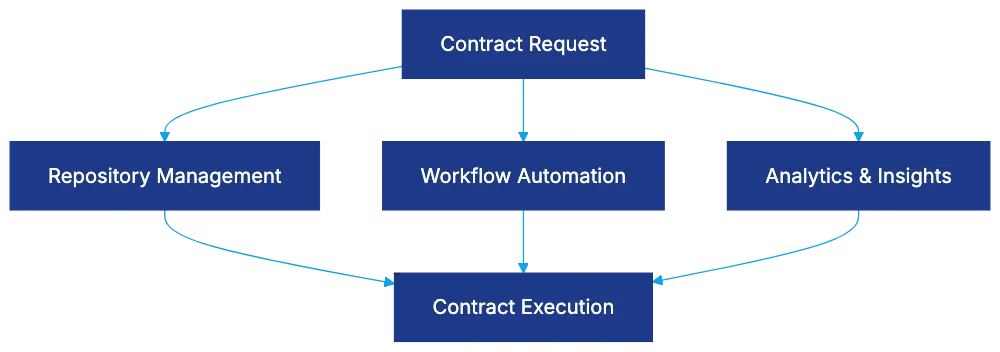
Contract automation uses workflow management for creation and approval, with no-code platforms setting approval chains. Logical routing streamlines processes, avoiding bottlenecks.
Analytics turn contract data into insights. Real-time dashboards reveal volume, cycle times, and approaching deadlines, with predictive analytics enhancing management.
Repository Management: Making Contracts Findable
Centralized storage solves the problem of scattered contracts. CLM systems pool contracts into one source with version control. Machine learning automates metadata entry, while advanced search interprets legal concepts, exceeding keyword limitations.
Role-based controls regulate access to sensitive contracts. Audit trails document changes, assisting in disputes or audits.
Workflow Automation: Eliminating Contract Bottlenecks
Automated Contract Workflow:

Contract approval workflows falter for typical reasons like absence or lack of urgency recognition. Automation mitigates these by offering no-code workflow design and conditional logic-based routing, as discussed in McKinsey’s report on digital transformation.
Deadline escalations send reminders and elevate actions to prevent lapse in approvals, ensuring timely contract fulfillment.
Analytics and Obligation Management: Turning Contracts Into Data
To manage ongoing obligations, CLM automates mundane tasks. Dashboards offer insights into portfolio health, spotlighting inefficiencies and providing alerts. Predictive insights warn of potential risks, and spending analysis identifies consolidation opportunities.
Platform Tiers: Enterprise, Mid-Market, and SMB Solutions
Choosing correct CLM software avoids costly errors.
Enterprise platforms like Icertis and Agiloft meet global needs, handling complex contracts and integrating with major systems. Customizable tools cater to unique business processes; costs are significant but justified, as noted in Gartner’s Magic Quadrant for CLM.
Mid-market solutions like Ironclad and Juro offer robust features with shorter setups. They provide strong ROI for their price range.
SMB solutions facilitate rapid deployment with simpler interfaces. They suit organizations handling fewer contracts, providing essential features at an affordable price.
Platform-Specific Capabilities Worth Knowing
Understanding particular capabilities helps align platform choices.
Ironclad offers seamless Salesforce integration. Icertis provides AI-driven intelligence for complex contract scenarios. Evisort focuses on compliance with robust AI training,
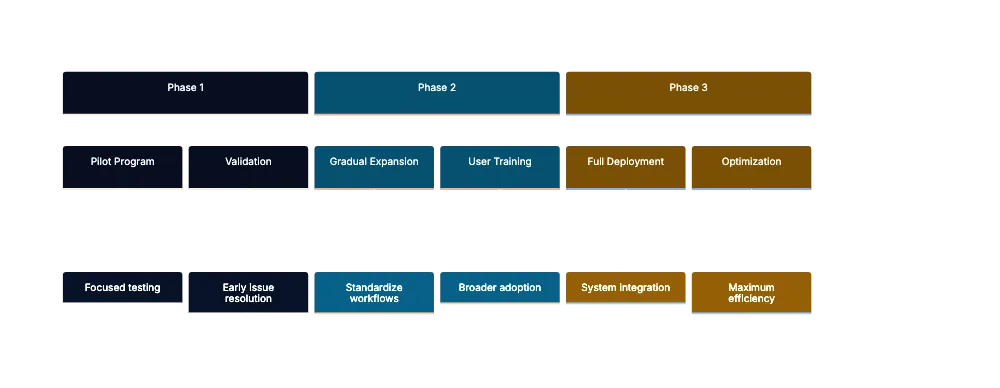
CLM Implementation Phases:
 while Agiloft allows extensive customization for unique processes.
Setup Best Practices: Phased Rollout Approach
Clear implementation phases avoid chaos and enhance value.
Phase 1: Run a pilot with focused goals. Validate platform value and correct mistakes early.
Phase 2: Expand gradually, standardize workflows, and engage more users. Effective training is crucial.
Phase 3: Full deployment integrates with business systems for maximum efficiency and cycle time reduction.
Avoid change management pitfalls, prioritize data quality, and redesign processes rather than digitize inefficient past methods.
Combining Strategies: Connecting CLM to Business Systems
Integrating CLM with business events achieves centralization. Salesforce, procurement, HR, document generation, and signature platforms enhance contract handling in real time, as explained in OpenAI’s research on AI integration.
Measuring CLM Success: Metrics That Matter
Focus on business value over system analytics.
- Cycle time reduction: Show significant savings over time.
- Contract visibility: Aim for comprehensive repository inclusion.
- Obligation compliance: Minimize risks by adhering to deadlines.
- Cost savings: Justify investments by showing financial savings.
Common CLM Challenges and How to Solve Them
Address potential setup obstacles proactively.
- Data quality: Ensure standardized metadata.
- User adaptability: Streamline workflows to encourage use.
- Integration challenges: Set realistic initial goals.
- Template variability: Rationalize before setup.
End
CLM software addresses contract challenges like scattered documents and missed obligations effectively. Different solutions cater to varied needs from SMBs to global enterprises. Aligning capabilities with requirements, gradual implementation, and targeted metrics leads to success. Empower legal teams and stakeholders with proper platform selection and effective management.
Frequently Asked Questions
What are the key benefits of using Contract Lifecycle Management (CLM) software?
CLM software centralizes contract storage, automates workflows, and provides analytics, which helps streamline the contract management process. It reduces risks associated with missed obligations and allows for efficient tracking and retrieval of contracts, ultimately saving time and increasing compliance.
How can a business determine which CLM solution is right for them?
Choosing the right CLM solution involves assessing the organization's size, complexity of contracts, and specific business needs. For smaller businesses with fewer contracts, SMB-focused solutions offer essential features at a lower price. In contrast, larger enterprises may require more robust, customizable platforms that handle complex integrations and global requirements.
What are some common challenges faced when implementing CLM software?
Common challenges include ensuring data quality, user adaptability, and integration with existing systems. Organizations may also struggle with template variability and the need to streamline workflows. Addressing these potential issues proactively can facilitate a smoother implementation process.
How important is user training when rolling out CLM software?
User training is crucial for successful adoption of CLM software. Engaging users during the implementation phase and providing comprehensive training ensures they understand the new system, which can lead to increased efficiency and minimized resistance to change.
Can CLM software integrate with existing business systems?
Yes, many CLM solutions can seamlessly integrate with existing business systems such as Salesforce, procurement, and HR platforms. This integration helps enhance contract handling by ensuring a centralized approach and real-time visibility across different business functions.
What metrics should be monitored to measure the success of CLM implementation?
Success metrics include cycle time reduction, contract visibility, obligation compliance, and cost savings. These indicators help assess the effectiveness of the CLM software and its impact on the organization’s overall contract management process.
What is the phased rollout approach in implementing CLM software?
The phased rollout approach involves three main stages: conducting a pilot program, gradually expanding with standardized workflows, and full deployment with system integration. This method allows organizations to validate the software's value, train users, and maximize efficiency while minimizing disruption.
Related Articles

Ironclad's Unique Approach to Contract Management
Explore Ironclad's innovative contract management platform, emphasizing automation, AI, and seamless integrations for legal teams.

Understanding Contract Analytics Software
Discover how contract analytics software transforms legal agreements into actionable data for efficiency and insight.

Luminance Review: Transforming M&A Due Diligence
Discover how Luminance's AI revolutionizes M&A due diligence with advanced multi-language support and efficient document analysis.