
12 Best AI Contract Review Software in 2026
Table of Contents
- Introduction
- LegalOn: Attorney-Maintained Intelligence
- Harvey AI: Partnership-Driven Language Models
- Luminance: Proprietary Legal-Grade LLM
- Kira Systems: Pre-Built Smart Fields at Scale
- Spellbook: Microsoft Word Native Integration
- Robin AI: End-to-End Contract Lifecycle
- Juro: Contract Collaboration Platform
- Ironclad: Digital Contracting System
- Evisort: AI-Powered Contract Intelligence
- ContractPodAi: Legal Lifecycle Management
- LinkSquares: Contract Repository with AI Analysis
- Summize: Contract Review in Existing Workflows
- Comparison Table: Key Features and Pricing
- Selection Criteria: Choosing the Right Platform
- End
- Introduction
- LegalOn: Attorney-Maintained Intelligence
- Harvey AI: Partnership-Driven Language Models
- Luminance: Proprietary Legal-Grade LLM
- Kira Systems: Pre-Built Smart Fields at Scale
- Spellbook: Microsoft Word Native Integration
- Robin AI: End-to-End Contract Lifecycle
- Juro: Contract Collaboration Platform
- Ironclad: Digital Contracting System
- Evisort: AI-Powered Contract Intelligence
- ContractPodAi: Legal Lifecycle Management
- LinkSquares: Contract Repository with AI Analysis
- Summize: Contract Review in Existing Workflows
- Comparison Table: Key Features and Pricing
- Selection Criteria: Choosing the Right Platform
- End
Introduction
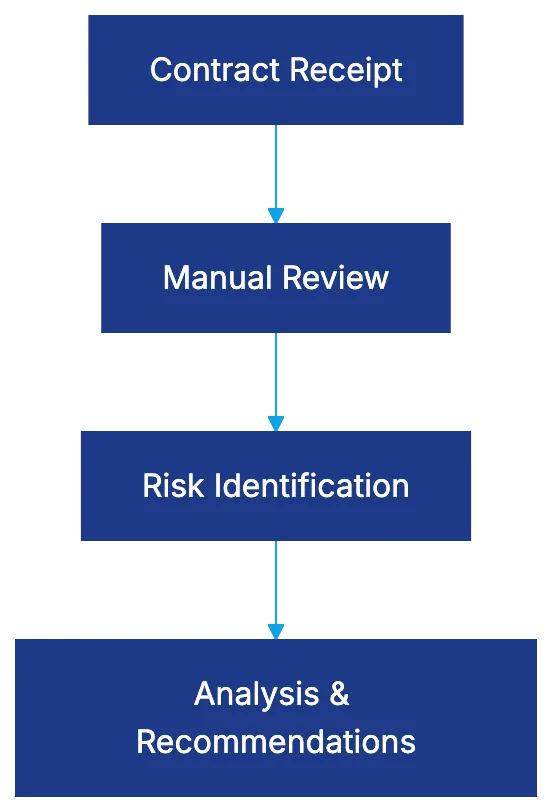
Contract review remains one of the most time-intensive tasks in legal practice. A commercial contract review can consume three to five hours of attorney time, with complex agreements taking longer. AI contract review software has matured significantly, surpassing simple clause extraction to perform analysis akin to junior associate work. It uses purpose-built legal language models rather than generic AI. This comparison examines twelve platforms showing effective gains in real-world settings. The top AI contract tools differ; some deliver immediate value with attorney-maintained playbooks, while others need months of training. Choosing the right approach determines whether ROI is achieved quickly or over a longer period.
Traditional Contract Review Process:
LegalOn: Attorney-Maintained Intelligence
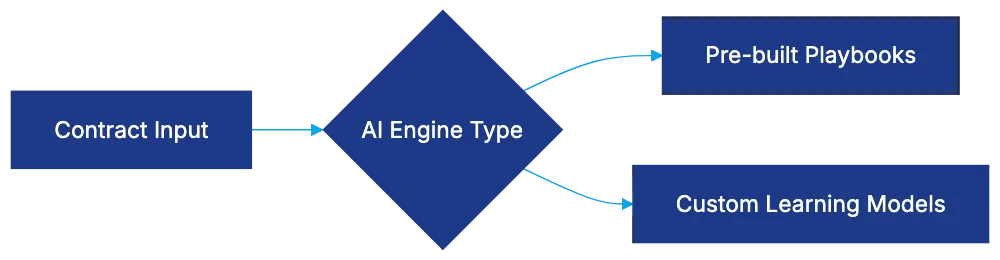
LegalOn leverages attorney-selected playbooks instead of unsupervised machine learning, with over 50 pre-built playbooks maintained by in-house attorneys. Independent testing scored LegalOn at 92 out of 100 for accuracy in identifying risks and deviations. The platform offers immediate value, bypassing extensive training by continuously updating playbooks. Pricing starts at $150 per review for standard agreements, with discounts for volume. It excels for consistent analysis but may require custom playbook supplementation for specialized contract types. G2 ratings show 4.6 out of 5 stars.
Harvey AI: Partnership-Driven Language Models
Harvey AI partners with OpenAI to use custom legal language models that extend beyond standard GPT architecture, incorporating retrieval-augmented generation. It added 10 billion tokens of US case law to its training data for comprehensive analysis. In testing, 97% of attorneys preferred Harvey’s output. The Trust Stack verification shows audit trails of AI decisions. Pricing is enterprise-based, targeting Am Law 200 firms, with costs from $75,000 to $500,000 annually. Capterra reviews average 4.7 out of 5 stars.
Luminance: Proprietary Legal-Grade LLM
Luminance built its own Legal-Grade LLM trained on over 150 million legal documents. The LITE engine uses pattern recognition to assess both explicit and implicit risks in contracts. It supports 80+ languages natively, eliminating translation bottlenecks. Different sub-models handle specific tasks, enhancing accuracy. Pricing starts at $30,000, scaling for enterprise deployments. It suits international practices, with G2 ratings of 4.5 out of 5 stars.
Kira Systems: Pre-Built Smart Fields at Scale
Kira Systems offers 1,400+ pre-built smart fields for 40+ practice areas. The platform allows custom smart field creation through its Quick Study feature. It serves 64% of Am Law 100 firms. Pricing is annual, starting at $25,000 with costs increasing based on usage. Kira is ideal for varied contract types, focusing on data extraction more than recommendations. Capterra reviews give it 4.4 out of 5 stars.
Spellbook: Microsoft Word Native Integration
Spellbook integrates AI directly into Microsoft Word, analyzing contracts within a familiar environment. The benchmarking feature compares terms against industry standards. Pricing starts at $40 per user monthly, with professional plans around $100 per user. It benefits firms using Word widely. G2 reviews show 4.5 out of 5 stars.
Robin AI: End-to-End Contract Lifecycle
Robin AI offers AI analysis with lifecycle management features like workflow automation and negotiation tracking. The system learns from attorney edits, aligning more closely with firm preferences over time. Pricing starts around $50,000 annually. Capterra ratings average 4.3 out of 5 stars.
Juro: Contract Collaboration Platform
Juro combines AI contract review with collaboration features, offering real-time editing and commenting. Smart templates allow self-service contract generation, and review features include automated approval routing and risk scoring. Pricing starts around $80 per user monthly. G2 reviews show 4.5 out of 5 stars.
Ironclad: Digital Contracting System
Ironclad digitizes contract workflows from request to post-signature management. It features Workflow Designer for approval chains and extracts key terms for a searchable repository. Pricing starts at $20,000 annually. Capterra reviews average 4.6 out of 5 stars.
Evisort: AI-Powered Contract Intelligence
Evisort transforms contracts into structured data, emphasizing intelligence that turns language into queryable information. It connects with systems like Salesforce and SAP. Pricing starts at $30,000 annually. G2 ratings show 4.7 out of 5 stars.
ContractPodAi: Legal Lifecycle Management
ContractPodAi provides comprehensive contract lifecycle management. Leah AI acts as a virtual assistant for contract queries. Pricing starts around $25,000 annually. Capterra reviews average 4.3 out of 5 stars.
LinkSquares: Contract Repository with AI Analysis
LinkSquares uses AI to make contracts searchable, automating ingestion from various sources. Pricing starts at $15,000 annually. Capterra reviews rate it at 4.5 out of 5 stars.
AI Contract Review Approaches:
Summize: Contract Review in Existing Workflows
Summize integrates AI review into tools like Slack and Teams, providing analysis in familiar interfaces. Pricing ranges from $50 to $100 per user monthly. Capterra reviews rate it at 4.4 out of 5 stars.
Comparison Table: Key Features and Pricing
| Platform | AI Approach | Key Strength | Starting Price | Best For | Rating |
|---|---|---|---|---|---|
| LegalOn | Attorney-maintained playbooks | Immediate value | $150/contract | Consistent analysis | 4.6/5 |
| Harvey AI | Custom LLMs | Deep analysis | $75K+ annually | Complex matters | 4.7/5 |
| Luminance | Propriety LLM | Multilingual support | $30K annually | International practices | 4.5/5 |
| Kira Systems | Smart fields | Extraction library | $25K annually | Varied contract types | 4.4/5 |
| Spellbook | Word integration | Familiar setup | $40/user monthly | Word-centric workflows | 4.5/5 |
| Robin AI | Lifecycle management | Unified platform | $50K+ annually | Lifecycle needs | 4.3/5 |
| Juro | Collaboration | Templates and editing | $80/user monthly | Standardized contracts | 4.5/5 |
| Ironclad | Contracting system | Workflow automation | $20K+ annually | Digital transformation | 4.6/5 |
| Evisort | Contract intelligence | Repository analysis | $30K annually | Large repositories | 4.7/5 |
| ContractPodAi | Lifecycle management | Virtual assistant | $25K+ annually | Total management | 4.3/5 |
| LinkSquares | Repository AI | Searchability | $15K annually | Storage organization | 4.5/5 |
| Summize | Integrated review | Workflow synergy | $50-100/user monthly | Collaboration focus | 4.4/5 |
Selection Criteria: Choosing the Right Platform
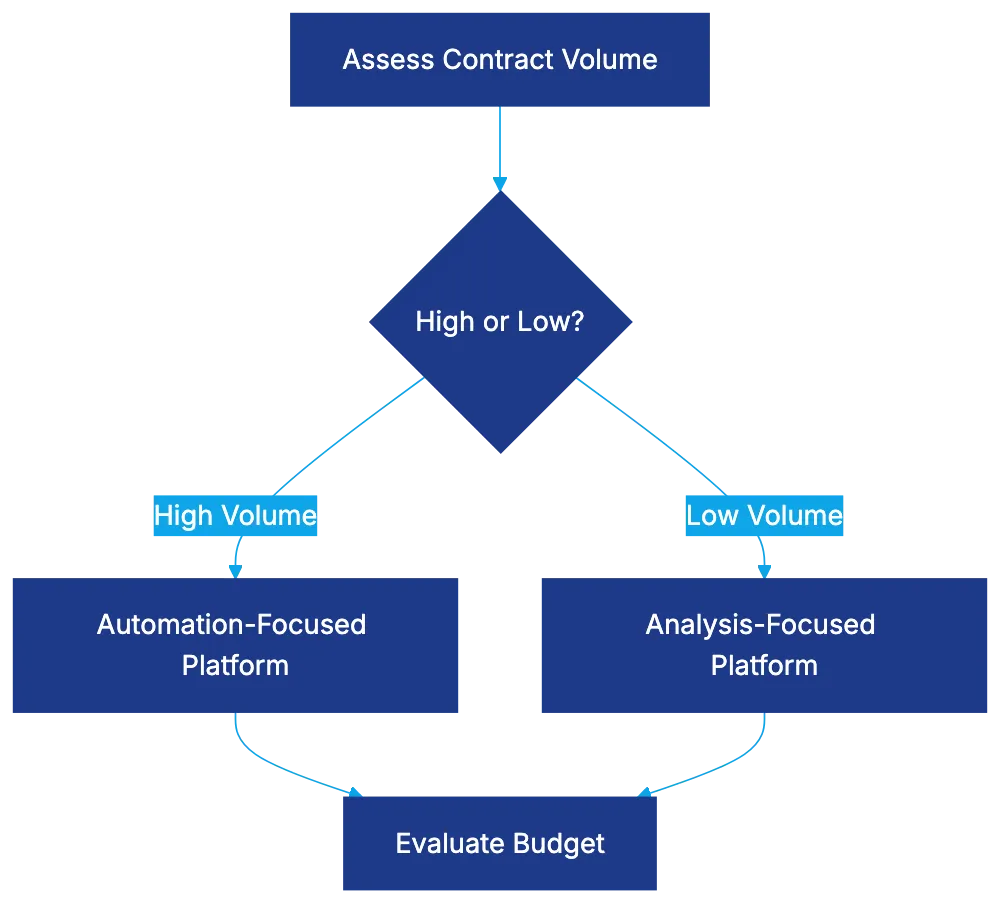
Selecting AI contract review software requires matching platform capabilities to your workflow and needs. Choose immediate value or customize to specific requirements. Platforms like LegalOn and Kira offer pre-built intelligence, while Evisort and Harvey provide deeper options. High-volume routine contracts suit Juro or Ironclad, while complex agreements need Harvey or Luminance. Budget affects choices, with low-cost options like Spellbook for smaller firms, versus enterprise options like Harvey or Robin for large volumes.
Technical sophistication and security needs influence platform selection. Some tools require operational or legal tech proficiency. Security requirements vary; firms need platforms with robust features for sensitive work. Most platforms offer cloud deployment, but options like Harvey AI emphasize transparency. Start with clear needs, acceptable pricing, and integration requirements. Request demonstrations using actual contracts to ensure capabilities match claims.
Platform Selection Decision Flow:
End
AI contract review software selection depends on contract types, volume, budget, and workflows. Large firms with complex agreements need systems like Harvey AI or Luminance. High-volume contracts benefit from automation-focused platforms like Juro or Ironclad. Smaller firms should consider cost-effective solutions like Spellbook. Despite advancements, AI remains a tool for handling repetitive tasks, requiring attorney oversight for strategic decisions. Clear requirements, feature needs, and cost alignment ensure the right fit, leading to measurable time savings quickly.
Frequently Asked Questions
How do I determine which AI contract review platform is right for my firm?
Choosing the right platform involves assessing your contract volume, types, and specific needs. Consider platforms that offer the immediate value of pre-built intelligence for routine contracts, while examining options that allow customization for more complex agreements. Budget and integration capabilities should also guide your decision.
What are the primary benefits of using AI for contract review?
AI contract review can significantly reduce the time attorneys spend on repetitive tasks, allowing them to focus on strategic decision-making. These tools can streamline risk identification and enhance accuracy in contract analysis, ultimately leading to faster turnaround times and improved efficiency in legal workflows.
Are there specific industries that benefit more from AI contract review tools?
While all legal practices can benefit from AI contract review tools, industries with high contract volumes, such as finance, real estate, and technology, may see more significant advantages. These sectors often deal with standardized contracts and require efficient management to keep pace with rapid transactions.
How much should a firm expect to invest in AI contract review tools?
Investment can vary widely based on the platform and the complexity of your needs. Pricing starts as low as $15,000 annually for basic systems, while enterprise solutions can cost upwards of $500,000 per year. It's essential to evaluate the potential ROI based on your firm's contract volume and specific requirements.
Can AI contract review tools completely replace lawyers?
No, AI tools are designed to assist rather than replace lawyers. They can handle repetitive tasks and provide insights, but strategic legal decisions, negotiations, and nuanced understanding still require attorney expertise and oversight.
What features should I prioritize when selecting an AI contract review platform?
Focus on key features such as risk assessment capabilities, integration with existing software, user-friendliness, and the option for attorney oversight. Additionally, assess the platform's ability to handle various contract types and its support for multilingual documents if applicable.
How long does it take to implement an AI contract review solution?
Implementation time can differ based on the complexity of the platform and the level of customization needed. Some tools like LegalOn offer immediate value, while others may require several months of training and adjustment to meet firm-specific requirements.
Related Articles

What Makes Juro Stand Out in CLM Solutions
Discover how Juro revolutionizes contract management for mid-market teams with its AI-native and in-browser approach.

Contract Management Software: Complete Guide for 2026
Comprehensive guide to contract lifecycle management software. Learn core CLM capabilities, platform tiers, implementation strategies, and vendor comparisons.
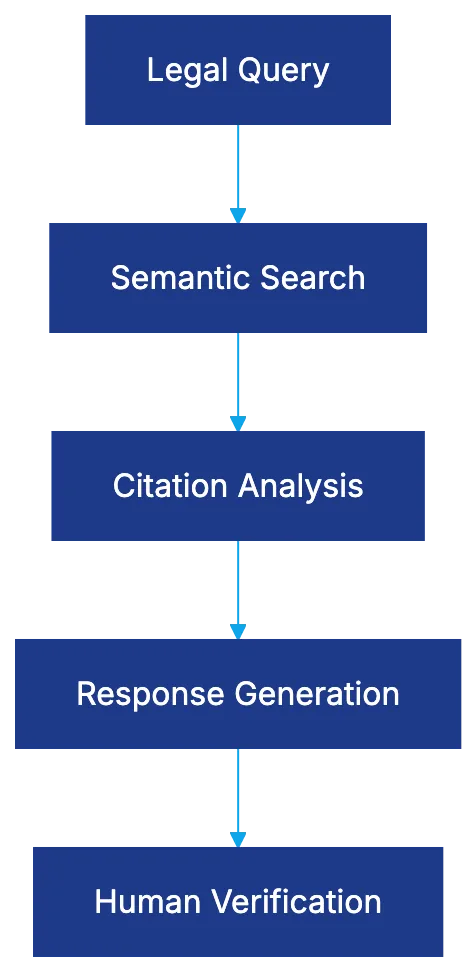
AI Legal Research: Transforming the Legal Industry
Explore how AI legal research tools are revolutionizing the legal field with enhanced accuracy and efficiency.